Would a tanto “build history over time” series keep collectors engaged?
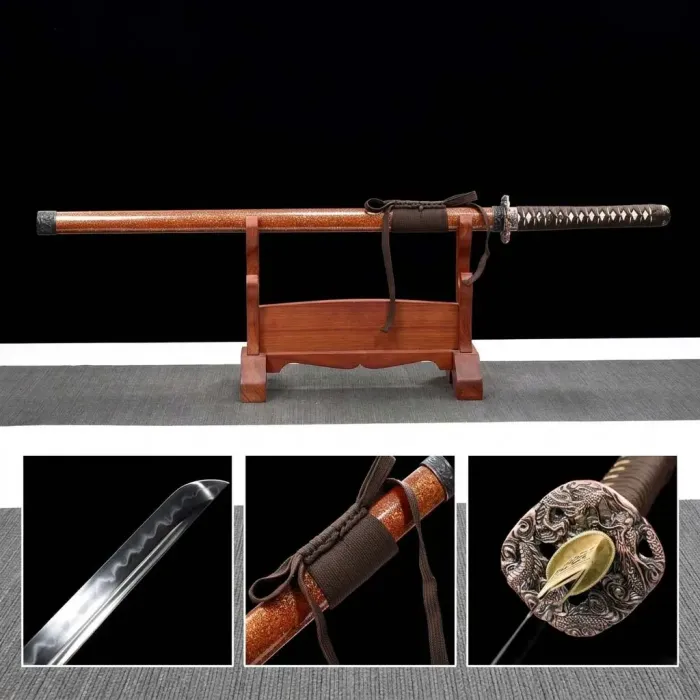
That customary eastern blade serves as a impressive showcase of talent, but suppose you long for to reveal your separate flair? Tailoring your weapon is a significant journey, allowing you to assemble a truly unique piece. From the grasp wrapping and fitting to the barrier design and temper line, each part offers a chance for custom touch. This inquiry delves into the world of katana customizations, providing tips for both newcomers and expert enthusiasts aiming to form their impression on the age-old art of the samurai.
Introductory Genuine Workmanship
For beginners eager to embark on the fulfilling journey of Japanese swordsmanship , 1060 steel katanas provide an outstanding entry point. This chosen grade of fundamental steel hits a optimal point between value and proficiency. While not as hard as top-tier steels, 1060 supports a suitable level of cutting preparation , making it suited for beginners to learn the basics of weapon preservation and value the appeal of classic Japanese weaponry. It’s a first-rate choice for obtaining experience without the pecuniary burden of more enhanced steels.
Grade T10 Cutlasses: Balancing Potency and Affordability
For specialists seeking an authentic cutting instrument experience without crossing the financial plan, T10 composition katanas represent a inviting option. These cutlery offer a distinct improvement in sturdiness compared to substandard alternatives, exhibiting respectable edge retention and enough flexibility for fundamental slicing techniques. While not rivaling the superior characteristics of fine steels like T100 or folded element , T10 provides a commendable blend of efficiency and cost-effectiveness , making them a widespread choice for beginners and those on a modest salary .
Exceeding the Steel : Customizing Your Weapon's Ornaments and Hilt
Although the glazed cutting edge is undeniably the primary point of a katana, truly elevating its grandeur lies in the deliberate customization of its hardware and hold. This method allows collectors to present their exclusive preference . Assess the extensive possibilities: menuki - decorative adornments that supply visual appeal ; the hamon sheaths – often masterfully engraved ; the tsuka nucleus itself, wrapped in traditional ito rope ; and the fusa pommel , which can be fabricated from various elements like treasures or antler .
- Choose subjects that align with you.
- Evaluate with diverse composites .
- Focus on robustness for a long-term result .
The Love of the Katana: Antiquity, Formation, and Composition
The samurai blade features a special allure, steeped in periods of Pacific Rim history and heritage . More than merely a device of skirmishing, it's a embodiment of the knight ethos – a fusion of competence and self-control . Its advancement spanned countless generations, with early blades evolving into the refined curvature and dangerous edge we accept today. The craftsmanship involved is truly astounding , requiring ages of instruction to complete. The process involves a intricate folding of refined metal , creating layers that fortify the instrument’s flexibility and slicing ability. Diverse schools of crafting appeared , each with their separate secrets and techniques for achieving the perfect poise and precision - a truly grueling pursuit.
- Original Katana styles
- The task of the katana in samurai culture
- Ancient forging techniques
Picking the Appropriate Steel for Your Cutting Tool Project: 1060 vs. T10
Opting for the ideal steel is vitally important for any cutting weapon project, and the determination between 1060 and T10 can be difficult. 1060 is a favored American alloy, offering a reasonable balance of durability and resilience, allowing it relatively easy to heat treat. However, T10, a Asian steel, habitually boasts amplified wear fortitude and can likely achieve a increased peak hardness, although it can be considerably demanding to work with and requires refined heat modifying. Consider your competency and targeted results: for a beginner, 1060 may be a prudent platform, while the seasoned smith might favor the additional details of T10.
- Manageability of Managing
- Abrasion
- Final Stiffness
Discovering Power: Refined Katana Adaptation Practices
Advancing competence in blade refinement extends far beyond basic honing. Serious enthusiasts are now studying advanced techniques to truly liberate a blade's hidden potential. This involves intricate work with the blade border, utilizing specialized compounds for differential annealing and carefully identifying the profile of the shield to optimize balance and effectiveness. Beyond purely functional enhancements, artisans are increasingly focused on reaching unparalleled aesthetic appeal, through complex cutting and layered coatings that truly transform a katana into a artistic composition.
From Ordinary Steel to Fine Blade: Fabricating a 1060 Katana
The journey commences with plain 1060 iron , a katana solid material far distant the fine katana it will evolve . Accomplished bladesmiths utilize a sophisticated process of layering and hammering the raw steel, repeatedly firing it and flattening it to extract impurities and establish a consistent grain structure. This demanding process, often stretching for weeks , builds the crucial solidity and give characteristic of a legitimate Japanese tool. Subsequent heat adjustments , including careful hardening and quenching , are necessary to achieve the aimed equilibrium of sharpness, endurance and beauty .- Doubling: Decreases impurities and generates grain structure.
- Forging: Models the steel into the initial blade form.
- Conditioning: Regulates the final hardness and flexibility.
The Perpetual Attraction of the Katana: Extensive Study of Steel and Alteration
Such long-standing katana survives a striking symbol within Japanese tradition , its attraction far overtopping mere arms and armor . Forged from traditional steel and often featuring intricate patterns , the method of creation itself is a respected art. Beyond the core craftsmanship, the ability to tailor a katana - from the temper curve to the haft wrapping and clasp - opens for a sincerely individual communication for both supporters and operators alike. This union of tradition-rooted steelwork and boundless personalization brings the katana's continued presence across the terra .
